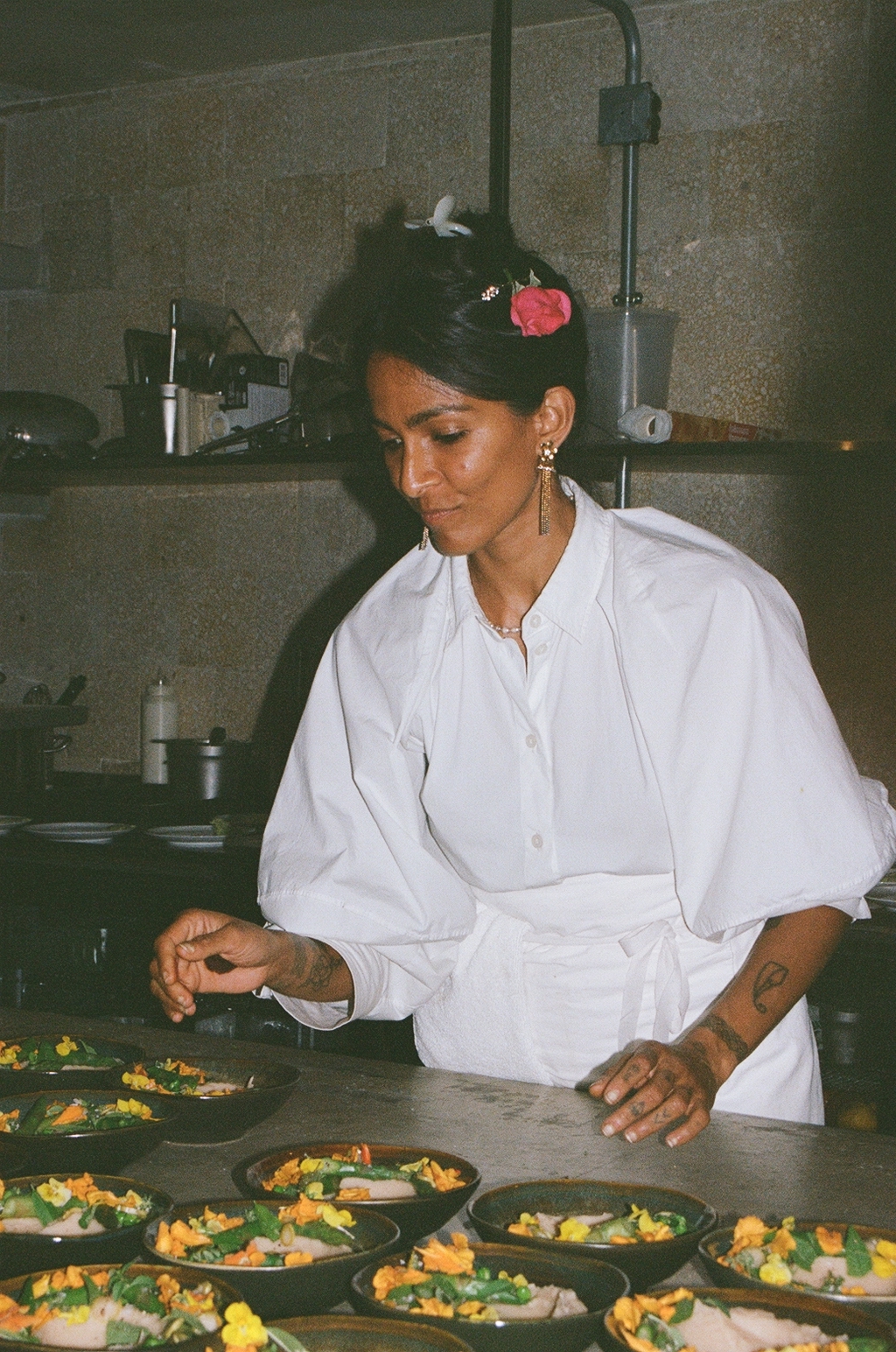
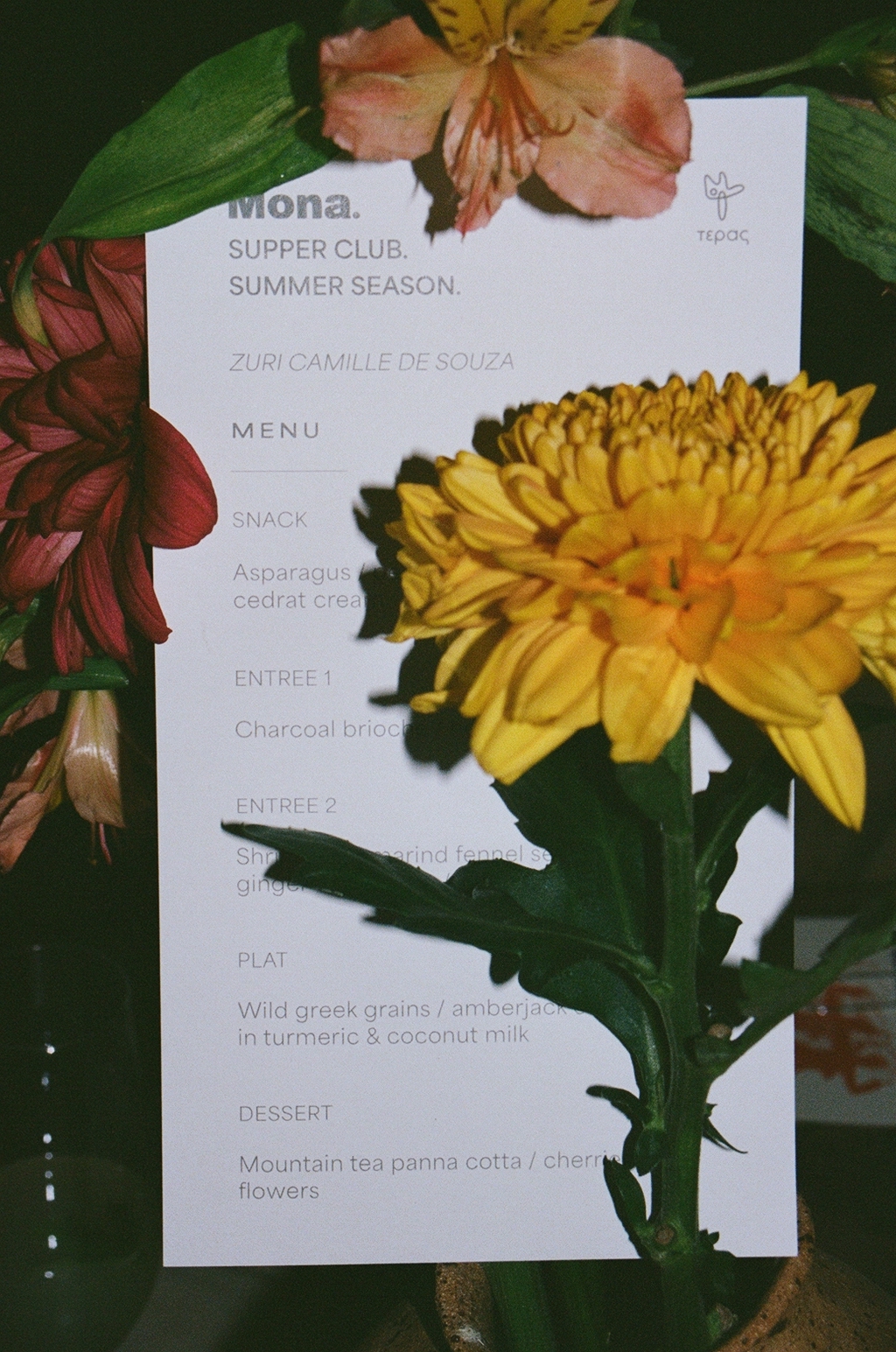
HOUSE OF SHILA (HOS): Your cooking practice is very inspired by your childhood and your parents in South India. Could you tell us a bit about how you were raised shaped your approach towards ingredients, cooking, dishes, and eating?
ZURI CAMILLE DE SOUZA (ZS): Although both my parents come from South India, their cultural and religious backgrounds aren’t the same. My father was born into a catholic family from Goa but living in Nairobi; my mother into a hindu family from Bombay and Pune but grew up between Trinidad, Hong Kong, Mauritius and Zambia. My parents both came back to India for college, during a time when India was growing herself as a country. They both grew up in a time of cultural questioning, critical thinking and socialism, and their own story is complex in the context of India; although diverse as a country, intercommunal, inter-religious interactions are very regulated by social customs and not necessarily welcome. I often thank my grandparents for how open they were. It might seem strange in the Global North to imagine marriages or love stories as matters of an entire family but at home, they most definitely are, even today.
This cultural métissage is something that my brother Zaeen and I both grew up with. We celebrated Hindu and Christian festivals, ate food that came from two communities, Goan and Maharashtrian; learnt our maternal and paternal languages and forgot them only to learn other languages; felt equally out of place and familiar wherever we went.
At home, so much is communicated through what we eat, it is such a powerful part of people’s identity. We were fascinated by the travelling our parents had done, the places they had seen; food was an intrinsic part of these stories we listened to—my grandmother Dora roasting Kenyan coffee each morning when they lived in Mombasa; the frozen Mars bars that my mother would buy after school in Hong Kong; the Dutch neighbour’s daughter who would sneak into my Aji’s kitchen to eat freshly made rotis with them; the picnics in Zambia.
Along with these narratives, my parents also spoke of the landscapes they encountered–the hills and forests and beaches, the oceans they sailed across to come back to India, the gardens they tended to. From our house in a village in Goa where I was born to the small city houses, my father always found space to make a garden. Nature was something to value and care for, we were taught this from a young age.
My approach to food is born out of all these childhood experiences, I think!
HOS: How do you experience the way that food can teach us about ourselves, our identities, perhaps even our desires?
ZS: I think food is a reflection of the things we value and in that sense can teach us about our desires for ourselves, for others, for the world. It can be a little glance into our dreams–when we cook with honesty and truth. Of course, it can be conceptual and complex and an exercise in technical skill, it can be a dreary task one might do to earn a living, it might be done with the kindest intention yet the simplest products. It could just be a pure expression of ego. I’m currently reading three interviews by John Coltrane (Je pars d’un point et je vais le plus loin possible : Entretiens suivis d’une lettre à Don DeMichael) and it is helping me understand my creative process as a chef and how I would like to engage with my cultural identity through my food.
HOS: Your practice often circles around words such as joy, pleasure, and ritual, what is the role of such positive emotions and the heartfelt methodologies that might conjure them?
ZS: When I started cooking–not too long ago, in 2019–I just felt such a separation between the emotions I value and the ways people often cook in the kitchen. Although cooking is a hard, back-breaking job (quite literally), I just started to ask myself at some point why I had to subscribe to those emotions to get better. I do believe in discipline and rigour and hard work, I don’t think there are shortcuts to doing something well but I prefer to imagine cooking as dancing or playing music in an ensemble rather than imagining it as a military composition as it is often portrayed.
In both the dance and music I enjoy, there is such a fine balance between freedom and communal understanding. There is joy, there is pleasure, there is dedication. There is a harmony between ideas and the body, there is hard work, there is practice. And I believe that when all of these things come together, there is something deeply spiritual and ritualistic about my work.
HOS: Your IG handle sensualecology is the first time I’ve seen those two words juxtaposed. They feel so luscious. It also seems you might have coined the term (?). What does sensual ecology mean?
ZS: Sensual ecology is something I thought of whilst working in Dubai. Sounds strange, I know. I actually wanted to study urban design and got into Parsons The New School in NYC. However, I needed to work in order to finance my studies and so after deferring for a year, I found a job doing graphic design in Dubai through a friend. It was such an absolute shock for me to find such a separation between what is constructed and what is natural and I began finding such delight in discovering little plants and natural spaces that subverted the rigid urban planning and construction. I found a certain poetry in the way things managed to grow in such unforgiving climates, in the simple expressions of wildness that I came across through the city–bougainvillaea flowers on a sandy pavement that hadn’t yet been swept up and cleaned, milkweed shrubs growing through scaffolding on abandoned construction sites, acacia with budding leaves. It reminded me that the desert below us was once an ecosystem with its own intricate balance. I eventually lost my job and didn’t make it to Parsons (don’t be sad, it worked out perfectly!) but I spent a month in Dubai before leaving trying to figure out what to do. I started interviewing friends about their memories of nature, exploring the emotional qualities of landscapes (I was also reading the Poetics of Space at the time, a book I still hold dear) and realised then how much of our perception of nature is sensual, tactile, emotional. I think I just want to bring attention to the sides of nature that are less technical and productive and more ethereal, immediate and intuitive.
“Food is inherently political—historically in India, the type of food one eats, the amount of food one eats, when one might eat; all these things are decided by caste, class and gender.”