Full Width Scroll

In The Pursuit Of Aesthetic Pleasures

air

Lydia Roberts

"[Photography] is an obsession, not a career. I don't really care about making money. I simply can't help but do it. I want to see something new every day."

England-born artist and image-maker Lydia Roberts’ practice is driven by instinct and an almost compulsive fascination with image creation. Her timeless photographic vignettes of the human form emerge from emotive intuition and a fierce imagination, existing entirely outside institutional logic or approval.

Roberts began her path as a teenager under the mentorship of photographer Brett Walker, within a circle that included her long-time friend Jack Davison. After cutting ties with her agent, she turned toward painting, travelled widely and now lives with her husband in a small village in Occitanie where she is wholly consumed by making art every day.

During her residency at House of Shila, spent between Mona and Shila Athens, Lydia unveils her temperament: that of a passionate outsider, propelled by an almost inescapable creative force — as if it were a private language only she can speak. Over several sittings, conversations unfold around photography as salvation, the pull of motherhood, and the quiet freedom of remaining outside the need to explain oneself.


Interview & Portraits EFTIHIA STEFANIDI 


ES: Is this your first time doing a residency? 

LR: Henrik Delehag invited me to take pictures in his converted church tower in London, but that was an informal residency. This is my first ‘official’ one.

ES: How was your experience alternating between Mona and Shila ?

LR: It’s been incredibly inspiring. I had the freedom to be myself. That’s something rare. Normally, when I stay somewhere, it’s because I’m there for a purpose – to make something for someone – so I’m never fully relaxed. But here, I felt free. Also, I don’t think I’ve ever stayed in a place where literally everywhere I look I think, “This wall could be used. This corner could be used.” I haven’t stopped since I arrived. I’ll spend five hours on the street, come back, edit, shoot self-portraits, edit again… If I’m not taking pictures, I’m with my sketchbook.

ES: This is your first time in Athens. Impressions?

LR: Everything feels new. I’ve enjoyed the faces here, the light, tiny bits of crispy paint on a wall. That’s what I call beautiful. I’m sure the history and culture are incredibly rich too, but after a week in Athens I still feel like I haven’t really been to Athens. I didn’t allow myself to sit in a restaurant or do anything touristy. I just focused on pictures. For me, everything goes into the making. If I came back again, I know I’d still be shooting the street. 


[At Mona and Shila] I had the freedom to be myself. That’s something rare.


photography by EFTIHIA STEFANIDI 

ES: Is Instagram your primary image platform?

LR: Yeah, unfortunately. Instagram helps, because I’m invisible without it. But I hate it. I’m playing to the algorithm and I have to constantly think: “I’d better post. I’d better do a carousel. I’d better put a caption. I’d better add a song….” It’s all taking away from the picture. I feel like I’m prostituting myself. I miss Flickr! It was so pure. A safe bubble for photographers.

ES: Big fan of Flickr! It was through that platform you met your photographic mentor, Brett Walker, right? 

LR: Yes, in 2008. I was a kid with no idea what photography was, taking pictures of all the things in my bedroom. I think Brett commented on one of my pictures and asked if he could take a portrait of me. When I saw his work, it was like peeking into a dark planet I had never laid eyes on before. I was a bit of a troubled teenager, so the timing was right. My mum trusted him and took me to meet him in London, and it literally saved me. That’s why photography is an obsession, not a career. I don’t really care about making money. I simply can’t help but do it. I want to see something new every day. Without Brett, I don’t think I’d have this discipline. He always told me to shoot every day.

ES: There’s something quite noble about not wanting to pursue a career in photography, but simply enjoying the act of it. I imagine that kind of distance gives you a great deal of freedom. What happens, then, when you’re commissioned for a job and have to answer to clients?

LR: I know how to be polite, come across as a professional, but I’m so particular about getting something for myself. I was never cut out to be the ‘professional’ photographer. I’ve done a few commercial jobs that have aligned with what I’m interested in.

ES:  They say  “character is fate.” And not all artists are cut out to be hustlers. That’s where agents and galleries may be useful. What is your relationship with galleries? Have you sold work that way?

LR: I’ve never really done the gallery thing. When I was eighteen, I had an agent for a couple of years and showed work in Paris. I was a teenager shooting provocative self-portraits, and it felt like I was put into a box and exploited because of my age. That experience gave me a distorted view of the art world. I decided to leave it behind and go to university to study painting.

I got a job in a kitchen and realised that working a normal job fueled me. It put one foot in the real world. I got to see faces. I fought for my time to create. After a 15-hour shift in the kitchen, I’d come home and spend five hours in my sketchbook even if I was exhausted, because that’s what I had to do. I was very anti-artist in my youth. Now things have shifted a little bit. I’ve got a house, I’m hoping to have children. There’s this horrible tension between instinct and putting one toe in the art world. 

photography by EFTIHIA STEFANIDI 

ES: I know what you mean. When that tension arises, it can help to return to the origins. I remember myself at a young age, always with a video camera in my hand, capturing life. There was no other noise behind why I was doing what I was doing.

LR: The best thing I got from art school was one of the lecturers saying, go back to your childhood. Go back to when you remember drawing at the table and what interested you then. That’s so potent. And it’s so true. I remember the feeling of having no right or wrong way of doing something. I’ve tried to carry that concept with me. With painting and photography, I’m never afraid of making mistakes. Everything is a mistake. Art exists in how you choose to decorate that mistake and present it to the audience. It’s just curiosity. I think that’s key, to be curious, to keep exploring. And I like imperfections; our house is full of them. I love Mona for that. 

ES: What intrigues me in your images is their cinematic, almost noir atmosphere, and the way they resist any fixed chronology. Did this way of seeing develop over time?

LR: Brett gave me a USB stick when I was 14. Saved on it were countless images he’d collected over many years, including found images from the 30s and 40s. I set it as the screensaver on my computer and kept it for years. These images must have been subconsciously absorbed. If I hadn’t met Brett, maybe my style would be different. But it wouldn’t be something else. I don’t even think of it as a style. It’s the thing I do every day. You brush your hair or your teeth and the bristles look a certain way after so many years. People often ask me how to build a style, so I’m trying to do now what Brett did for me. I’ve taken on a couple of online students. It makes me reflect on why I’m doing this every day and what I can give to other people. I learn a lot. 


Art exists in how you choose to decorate a mistake and present it to the audience. It’s just curiosity.


artworks by LYDIA ROBERTS 

ES: The industry often feels compelled to define artists. How do you navigate that impulse—and have you ever defined yourself?

LR:  I was invited to Antwerp for a talk recently, which forced me to think about my work. All I can say is that I just like making pictures. I don’t see what I do as technical photography. It’s image-making. I don’t know anything about cameras, really. I’ve only just arrived at understanding the F-stop. 

ES: Do you ever experience imposter syndrome?

LR: Some years ago, I had my first big job where I was definitely out of my comfort zone and felt a sense of not belonging to that environment.

Luckily, I had a great assistant who did technical stuff and I managed to focus on the part I know how to do, the making! But it’s strange to do this in front of an audience. I’m used to shooting in my room mostly. The styling, the makeup, the hair—I do it myself. And that is why if I start saying I’m a photographer, it’s kind of weird. In the French village where I live, when people ask what I do, I say I’m an English teacher. If I know you really well, I might say I’m an artist or a photographer.

ES: Do you go to photography fairs?

LR: I feel like I should go to them but I don’t. Last year I was thinking ‘I should really go to Paris Photo’ but I imagined myself there. Nobody knows who I am, I don’t have anything for them, I have to network. I hate that… I love to sit and talk about art, but if it’s under the pretence of using someone to get somewhere, I feel like it’s wasted energy I’d rather put into making it work. I know that may change if I have kids. At the same time, I’m also terrified of motherhood. For me, making pictures is everything. To the point I might struggle to walk the dog or to make dinner. Sometimes when I’m doing something, it’s like everything else closes down. 


“I love to sit and talk about art, but if it’s under the pretence of using someone to get somewhere, I feel like it’s wasted energy I’d rather put into making it work.


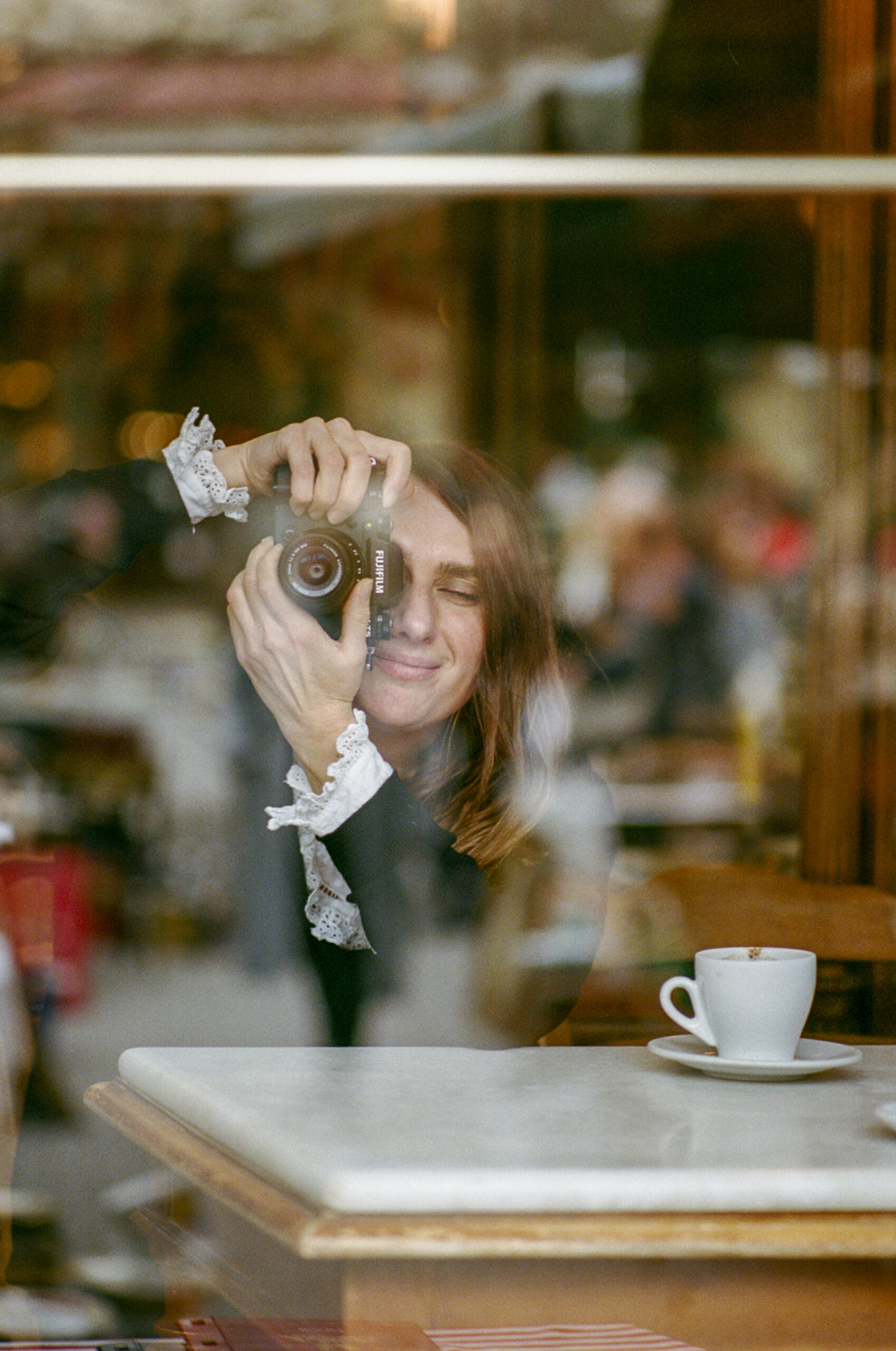
photography by EFTIHIA STEFANIDI  

photography by EFTIHIA STEFANIDI

ES: As they say, when you have kids, you are no longer the centre of the world—your ego shifts.

LR: I know, it is probably true, however, for some of us, it may not naturally happen like that. Not everybody is designed to know how to deal with this feeling.

ES: How do you respond to the discourse that has emerged in recent years around the notion of exploitation in photography?

LR: There have been so many moments when I’ve taken pictures and other people have said I’m being exploitative. I don’t agree. If you’re creating something that has the potential to transcend hate, that matters. There’s something deeply sacred in that act. If you work with negative intention, then yes—you can be an asshole. I hope I’m not.

ES: Were there any photographers you looked up to when you were younger?

LR: Francesca Woodman and Diane Arbus. But I can’t claim to say I know their work in any deep way—I’ve never seen it in real life. A couple of pictures on Google are enough for me. I’d love to say there’s a list of contemporary artists I’m following, but it’s a constant reel of endless images I scroll every day on Instagram. I’ve got my little safe space of saved pictures and there are a couple of people who curate nice images, but everything feels like it’s one giant Pinterest board. 

ES: When I interviewed Harley Weir during her residency, she mentioned that she avoids looking at other people’s work to keep from being influenced by trends.

LR: Exactly. All the big photographers right now—it’s the same moodboard. I’d rather just stay in my imagination. And the moment I start feeling like I should be taking a certain kind of picture, I step back. That’s the exact line an agent once said to me when I was younger: “We need you to start making…”. No one can tell me what art to make. Even if you’re paying me all the money in the world. I still feel like I know what’s best. Maybe that sounds arrogant, but it’s the only thing I can claim to say I know a little bit about.


“No one can tell me what art to make. Even if you’re paying me all the money in the world.


artworks by LYDIA ROBERTS

artworks by LYDIA ROBERTS  


ES: Do you feel like you know who you are? 

LR: There are moments when I feel it so strongly. Normally when I’m on my own, painting. Photography is mostly mechanical at this point. Painting is when I think more about my identity and myself. The feeling is, “Oh, I’m alive.” That’s my identity. I am alive, and I realise that. I’m no different from anyone else. I just make things. 

ES: Are you painting more these days?

LR: Yes, because I finally have a studio in my house. I studied fine art, but it was just three years of learning how to lie, how to consent to lies. I was the biggest outsider. Academically, intellectually, I do not consider myself a smart person. Visually, I can do a bit, but I struggle to justify why I’m doing this. Even my art tutor had to get to the bottom of why I’d chosen to put a painting on the floor instead of hanging it. But for me this is a simple gesture. I don’t have any layer of references. That means that sometimes when I’m asked to justify, I say, “Is it not enough that I just make it?”


Painting is when I think more about my identity and myself. Normally the feeling is, ‘Oh, I’m alive.’ That’s my identity. I am alive […]


photography by EFTIHIA STEFANIDI  

photography by EFTIHIA STEFANIDI


ES: Does being an outsider make you feel like you participate less in life? 

LR: Definitely. That’s why, despite hating Instagram, I also weirdly like it in other ways. It gives me a window into the world that other people live in, to which I feel completely alien. When I see people going to have dinner or hanging out with friends, or even just the simple thing of sitting at a cafe and having coffee—I just don’t do those things. But I don’t feel lonely. When I was young though, I felt I was an alien. As I got older, nothing really mattered. That’s my mantra. If I’ve had a bad day, I’ve got bills to pay, or this important person doesn’t email me back—ultimately nothing matters. 

ES: That’s a liberating state to be in. 

LR: We can just remind ourselves that everyone’s going to die. It’s not a morbid thing, it’s just a matter of fact. None of us gets out alive. We’re all kind of playing a game. It’s a meaningless personal game. And that gives meaning to what I do, in some weird way. 

ES: What happens to all the pictures we take as photographers? Do we care? For a legacy? 

LR: Sometimes I don’t care at all. It sounds bad, but it’s true. If my archive burned in a fire, I think I’d survive. There’s something ephemeral about it. On the other hand, I get to look back sometimes at my life that exists online. I can return to my first Flickr account and see those early pictures and realise how special that time was. And how dark. I was taking raw, difficult, sometimes ugly pictures of myself. They’re relics. That’s the part of photography that truly matters to me—the documentation. 

ES: What compels you to take photos?

LR: I’d love to say there’s a deep poetic reason for why I shoot, but it started from an intense need to survive. It saved me. Photography fixed me when I needed fixing. Now, I don’t shoot to fix myself—I shoot because it’s all I’ve ever known. I don’t even really follow the news. I don’t have much of a social life. I can only handle a few things: my relationship, paying my bills and taking pictures. Everything else feels like too much. 

ES: A life most simplified. 

LR: I live in a tiny village with almost no people. I say hello to my paintings in the studio because the women I draw feel more real to me. I love brief, intense encounters, but I don’t feel the need to maintain many relationships. I feel closer to children than adults. Think of how they see the world—there’s no fear of judgment. Adults are always silently performing, always judging. My life is full of performance. Even when I teach, I’m performing.


“We’re all kind of playing a game. And that gives meaning to what I do […] I’d love to say there’s a deep reason for why I shoot, but it started from an intense need to survive. It saved me.


artworks by LYDIA ROBERTS  

artworks by LYDIA ROBERTS

ES: What is your dream?

LR: I’m living mine. Truly. I never imagined that I would live in another country, have my own house, be with someone I love or make a life through photography. When I was young, I genuinely thought my path would be self-destructive. I had a moment when I consciously chose life. And that changed everything. I now care less about how I look in the world and more about being real. 
MORE FEATURES