Full Width Scroll

How are you feeling today?|Welcome Back|MONA'S MARCHE December 13 + 14 @ Mona Athens

air

Sonia Sieff

"For years I dreamt of a poetic and authentic viewpoint on male nudity, but most of the books I found were hyper-sexualised and far from the love letter I had in mind."

Sonia Sieff is a French visual artist, the wunderkind daughter of two photographers, the legendary Jeanloup Sieff and Barbara Rix. Having honed her eye throughout years of travel and on sets around the world, she has developed an intimate body of work that reveals a masterful command of contrast.

Light and shadow move evocatively across the bodies of her subjects, showcasing – whether in landscapes, fashion editorials or the nude portraits that have become her signature – a sensibility for both tenderness and bold-faced authenticity.

Sieff’s critically acclaimed 2017 book, Les Françaises, explored the female nude from a feminist perspective, celebrating the individuality of each subject. Her follow-up book, RENDEZ-VOUS!, dives into the other side of the spectrum, reflecting a diverse selection of men captured in their habitat.

In September, Sieff’s pop-up exhibition arrived at Mona Athens, drawn from both book projects. HOS sat down with Sieff to talk analogue photography, the female gaze, and what it means to turn that gaze on men.


Interview & Portraits EFTIHIA STEFANIDI 


HOS: Your path to visual media started at 17, travelling and learning on film sets before moving into fashion photography. What first drew you to the camera?

Sonia Sieff: I was born and raised in the photography world. Photography is in my blood. Both my parents were photographers, and my family had a lab and a studio in our apartment in Paris. When I was a child, we would have intense discussions about the pictures my dad had shot during the day. Our dinners were animated with critical opinion. I guess that’s left a footprint, considering I decided to live the same way my parents did.


[It’s] a real provocation to show men through the female gaze […]


photography by EFTIHIA STEFANIDI

HOS: Your first book, Les Françaises, was a feminist ode to the female nude. Now, with RENDEZ-VOUS!, you turn the lens towards men. What was the biggest shift in perspective for you?

SS: Male nudes have fascinated me since I was young, and I’ve searched for tender explorations of the theme, but I could never find one. For years I dreamt of a poetic and authentic viewpoint on male nudity, but most of the books I found were hyper-sexualised and far from the love letter I had in mind. Even my publisher felt safer putting out a book of female nudes first—which, unfortunately, still far outsells male nudes. It’s representative of our society. I believe it’s a real provocation to show men through the female gaze; not in the exact same way we’ve seen women, but by proposing a new perspective.

artworks by SONIA SIEFF

HOS: What does “RENDEZ-VOUS!” mean to you in the context of your work?

SS: I wanted a title which sounds good in both French and English. A rendez-vous is a romantic proposition to which I could add my own personal twist. Putting an exclamation mark changes the meaning in French. It becomes the imperative tense, meaning ‘to surrender’. I found it a good title to trigger and define the masculinity I was looking for.

HOS: How do you navigate intimacy, vulnerability and power when photographing nude bodies? And how does it feel to be a woman photographing male nudes?

SS: The men who accepted were brave. I could feel they were offering me the most intimate part of themselves—getting naked in front of someone they didn’t know, and with no seductive game. For most of them it was a real challenge, and I thank them.

The men who accepted were brave. I could feel they were offering me the most intimate part of themselves—getting naked in front of someone they didn’t know, and with no seductive game.


photography by EFTIHIA STEFANIDI

HOS: In your eyes, what differentiates the male body from the female body in photography—both technically and emotionally?

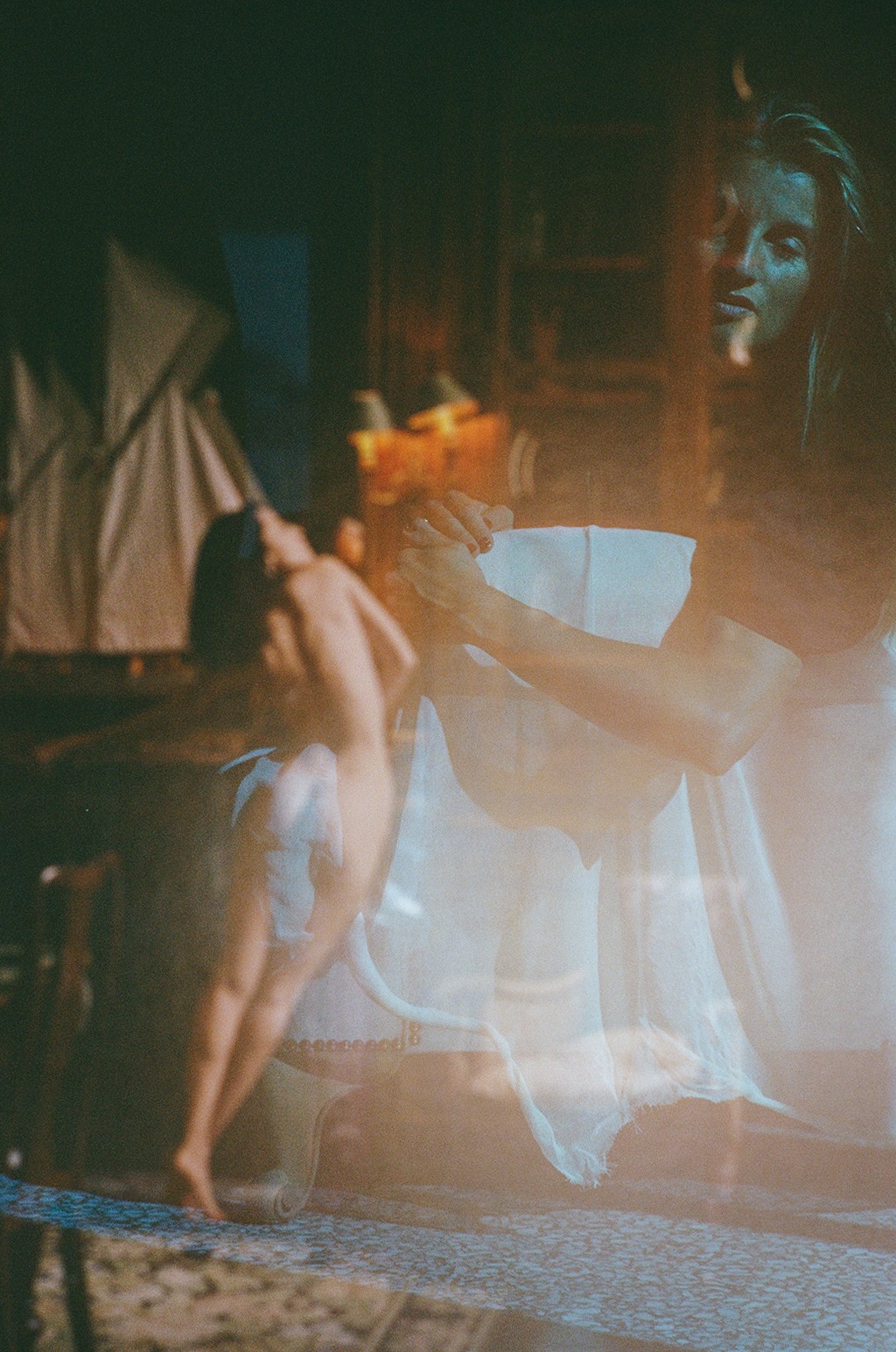
SS: Women ‘know’ how to pose, even if they’ve never done it before. We’re brought up – culturally; through art, magazines and movies – seeing naked female bodies. All of culture is mainly mediated by the male gaze, so in my books I didn’t want to play this game the other way around and neutralise the gaze. I wanted them to be, act and pose naturally in front of my lens.

HOS: Any interesting or memorable anecdotes from this series? 

SS: One man ate a tomato in a suggestive way, which really surprised me and made me laugh!

photography by EFTIHIA STEFANIDI

HOS: Many of your portraits are set in landscapes and interiors which carry an interesting weight. How do you choose a setting?

SS: For Les Françaises, interiors were part of the picture, and I needed to be connected to the space to have a good shoot. I was looking for astonishing locations: l’Opera de Paris, the Castle of Ilbarritz, Parisian apartments, the Mamo in Marseille, etc. For RENDEZ-VOUS!, I was more focused on intimacy, skin, being able to get closer to my models (who weren’t friends, contrary to the women I’d photographed). I mostly had a lot of fun, though some trips were more painful. When I stayed in Kyiv, just before the war, I could watch men training, and the spaces I shot were full of ghosts. 

HOS: When you were sequencing RENDEZ-VOUS!, what kind of narrative or rhythm did you want to create for the viewer? Do you see it as a diary, a choreography or something else entirely?

SS: Les Françaises was built in chapters, starting with the women’s names. RENDEZ-VOUS! mixes pictures. It’s more about rhythm. As for narrative, I shot men all over Europe during the pandemic. Back then, remember, humanity was all going through the same exact story. We were all, in a way, connected. It was a pause from our lives, and this made me want to revisit my first love—analogue photography. Meeting people for real. Being alone in front of men I was meeting for the first time. Being authentic and pure. 


All of culture is mainly mediated by the male gaze, so in my books I didn’t want to play this game the other way around and neutralise the gaze. I wanted them to be, act and pose naturally in front of my lens.


photography by EFTIHIA STEFANIDI

photography by EFTIHIA STEFANIDI

HOS: How much do you use social media – and particularly Instagram – for viewing photography? Do you think the medium, as a platform, is helping artists? Or is it draining creativity in the hunt for approval? 

SS: This game of likes is evil. At first it was seductive because photographers could show their work freely. But we’ve started seeking approval for not only our work, but also for our lives. It’s become terribly addictive and dangerous.

HOS: Do you think photography is, at its core, about seduction?

SS: It’s a confrontation, a conversation between the model and the photographer, in which the one who’s supposedly revealing herself in front of the camera is not so obviously the model.


This game of Instagram likes is evil. At first it was seductive because photographers could show their work freely. But we’ve started seeking approval for not only our work, but also for our lives. It’s become terribly addictive and dangerous.


photography by EFTIHIA STEFANIDI

HOS: Tell us about the perfume you’ve created alongside RENDEZ-VOUS!

SS: I wanted to create an ode to the iconic perfumes of the 70s. One of my dreams has been to create a fully experiential encounter around my visual art. I’m obsessed with fragrances, and I was fortunate to meet Stephanie from Grace Agency who introduced me to Antoine Lie and his incredible perfumes.

HOS: Why choose Mona as the setting for a pop-up exhibition in Athens?

SS: I’m honoured to start my Mediterranean trip in a country I deeply love and in a city to which I feel connected. Mona carries a strong poetic identity. It’ll be the first time I show both men and women, my two books united in one exhibition.

HOS: Last question. If your camera is a way of seeing—what is it you’re searching for? 

SS: I have an adventurous state of mind. I love exploring and hate routine, so I wouldn’t like to be limited to searching for only one topic or style. Landscapes, portraits, nudes, fashion, still life—I have a 360° overview, and all the pieces of my puzzle are slowly interlocking.
 

MORE FEATURES